Riding for the Disabled vs NDIS Equine Therapy: The Difference
If you or someone you care for enjoys being around horses, you may come across both Riding for the Disabled (RDA) and NDIS equine-assisted therapy while looking for support.
Both can create meaningful experiences for people with disability. Both involve horses. And both may help participants build confidence, connection or new skills.
But they are not the same type of service, particularly when it comes to NDIS funding.
Riding for the Disabled is primarily a community-based equestrian program that gives people with disability opportunities to participate in horse-related activities. Equine-assisted therapy, on the other hand, is a structured professional support linked to individual therapeutic or developmental goals.
Understanding that difference can help you choose an option that suits the participant and avoid using NDIS funding for a service that does not meet the relevant funding rules.
What Riding for the Disabled Offers
Riding for the Disabled has a long history of helping people with disability experience horses in an inclusive and supportive environment.
Riding for the Disabled Association Australia describes itself as a voluntary, not-for-profit organisation providing opportunities for people with disability to enjoy safe, healthy and therapeutic horse-related activities.
In Victoria, RDA programs may provide opportunities for:
- Learning equestrian skills
- Participating in mounted activities
- Building confidence
- Developing balance and coordination
- Socialising with other participants
- Taking part in games and structured activities
- Building independence around horses
- Connecting with a supportive community
Programs vary between RDA centres. For example, some Victorian centres focus on riding skills, games, obstacle courses, trails or dressage, while volunteers and trained coaches support participants according to their needs.
These experiences can be valuable.
For some participants, RDA may provide a sense of achievement, enjoyment, friendship and community participation that is difficult to find elsewhere.
The important distinction is that these benefits do not automatically make an RDA session an NDIS-funded therapy support.
What Equine Therapy NDIS Melbourne Support Offers
NDIS equine-assisted therapy starts from a different place: the participant’s disability-related needs and goals.
The NDIS describes animal-assisted therapy as evidence-based treatment where an animal is used by a qualified health professional to help a participant engage in therapy and work towards specific goals. The animal is one tool within the professional’s practice.
Depending on the participant and practitioner’s professional scope, those goals might involve:
- Emotional regulation
- Communication
- Everyday independence
- Social participation
- Problem-solving
- Following routines
- Functional skill development
- Confidence in everyday situations
The professional delivering the support should be able to explain why each activity is being used and what functional outcome it supports.
At Selective Support, equine-assisted sessions are fully ground-based and held at our Diggers Rest property in Melbourne’s north-west. Sessions are led by an experienced developmental educator and adapted to the participant’s communication style, comfort level, interests and goals. Activities can include grooming, observing horse behaviour, practising calm communication and structured problem-solving.
You can learn more about our NDIS equine therapy in Melbourne and how these sessions work.
RDA vs Equine Therapy: Funding Is the Key Difference
This is often where families become confused.
A horse-based activity can feel therapeutic without meeting the NDIS definition of a therapy support.
Current NDIS guidance specifically lists horse riding and recreational, sporting or social activities involving animals as examples of activities that are not animal-assisted therapy when they are not goal-centred and part of an evidence-based therapeutic treatment plan.
For animal-assisted therapy to potentially be funded, it must:
- Relate to the participant’s disability
- Be in line with their NDIS plan
- Be planned around individual goals
- Form part of evidence-based treatment
- Be provided by a trained and qualified health professional
- Represent value for money
- Meet the applicable NDIS pricing requirements
NDIS therapy supports must also be delivered by qualified allied health professionals who are appropriately registered or accredited for their profession.
Is Riding for the Disabled NDIS-Funded?
The ordinary cost of participating in a recreational horse activity is generally not funded as animal-assisted therapy.
However, this does not mean the NDIS can never support someone who wants to participate in an RDA or similar community activity.
The NDIS explains that it may fund additional disability support needed to take part in a recreational, sporting or social activity. For example, this could include a support worker or an assistive product required because of the participant’s disability.
The NDIS does not generally fund the ordinary participation costs that everyone would normally pay for the activity.
So, in simple terms:
RDA or similar programs:
The activity itself may be a recreational or community participation cost.
NDIS equine-assisted therapy:
The professional therapeutic support may be funded when it meets the NDIS criteria and fits the participant’s plan.
This distinction does not make one service better than the other. They simply serve different purposes.
For more detail on this funding line, read Equine Therapy vs Therapeutic Horse Riding: What the NDIS Funds.
You can also read Is Equine Therapy Covered by the NDIS? for a broader explanation of the current funding requirements.
Which Is Right for You?
The right option depends on what you want to achieve.
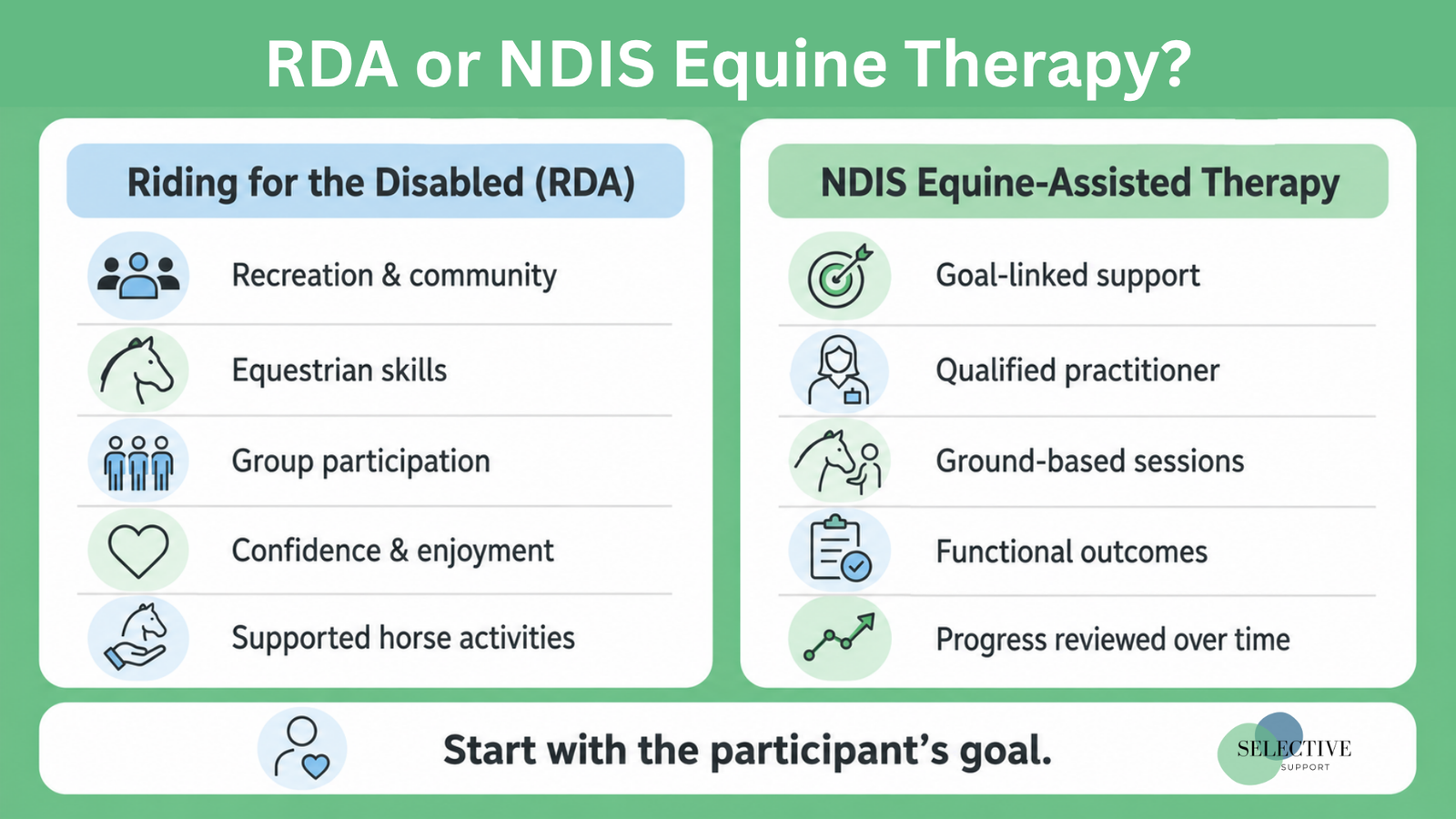
Start with the participant’s goal rather than the name of the program.
RDA may suit you if your main goal is:
- Enjoying a horse-based recreational activity
- Developing equestrian skills
- Participating in an inclusive community program
- Meeting people with shared interests
- Building confidence through recreation
- Enjoying structured time with horses
RDA can offer a welcoming community and meaningful opportunities for participation. RDAV describes its programs as supporting physical development, emotional wellbeing and personal growth through horse-assisted activities.
NDIS equine-assisted therapy may suit you if your goal is:
- Working towards a specific disability-related outcome
- Developing emotional regulation strategies
- Building everyday independence
- Improving functional communication
- Practising problem-solving or routines
- Working with a qualified practitioner on measurable goals
The key question is:
“Do I want an equestrian or community activity, or do I need a professional support linked to a specific disability-related goal?”
For example, someone may enjoy attending RDA because they want an inclusive recreational activity and opportunities to develop horse-related skills.
Another participant may need structured sessions with a developmental educator to work on sequencing tasks, communication, emotional regulation or daily-living independence.
And some people may enjoy both.
Riding for the Disabled and Equine Therapy FAQs
1. Is Riding for the Disabled covered by the NDIS?
The ordinary cost of recreational horse activities is generally not funded as animal-assisted therapy. The NDIS may fund additional disability support a participant needs to take part, depending on their individual plan and circumstances.
2. What’s the difference between RDA and equine therapy?
RDA primarily provides inclusive horse-related and equestrian activities for people with disability. Equine-assisted therapy is a professional, goal-linked support delivered by a suitably qualified health professional as part of therapeutic or developmental work.
3. Can I do both?
Potentially, yes. A participant might enjoy an RDA program for recreation and community participation while separately receiving equine-assisted therapy for specific disability-related goals. Whether NDIS funding can be used depends on the individual support being purchased and the participant’s plan.
Choose the Support That Matches Your Goal
Both Riding for the Disabled and equine-assisted therapy can create meaningful experiences with horses.
The difference is what the service is designed to achieve.
If you are looking for inclusive recreation, equestrian skills and community participation, RDA may be worth exploring.
If you are looking for structured, ground-based professional support connected to specific developmental or functional NDIS goals, equine-assisted therapy may be a more appropriate option.
You do not need to decide based on the name alone. Start with your goals, ask who delivers the service and understand how it fits your NDIS plan.
Looking for goal-focused, plan-funded equine therapy? Book a free chat.