

What is NDIS employment support?
NDIS employment support is funding in an NDIS plan for supports that help a participant get ready for work, find a job and keep it. The NDIS Guide to employment sets out the next step this way: "Your next step after you have employment support funding in your plan is to connect to a provider. They can help you build skills for work, find and keep a job." This guide is for NDIS participants in Melbourne who want to work, the family members who hold a plan with them, and the coordinators and plan managers who help them use it.
If the scheme itself is new to you, start with how the NDIS works and come back to this page.
What does NDIS employment support cover?
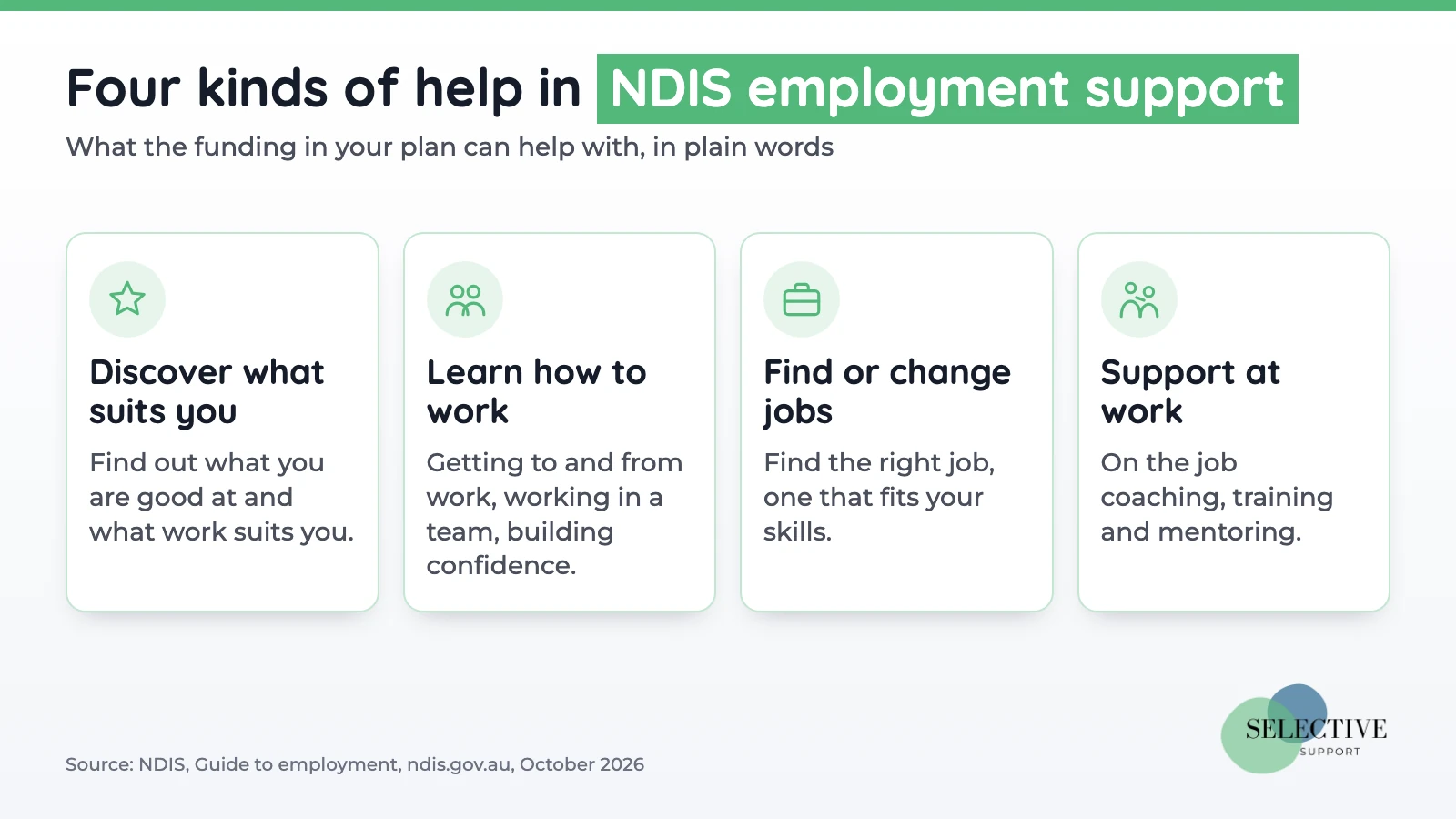
NDIS employment support covers four kinds of help: finding out what work suits you, learning how to work, finding or changing jobs, and getting support once you are at work. The NDIS Guide to employment says: "We can fund the following NDIS supports to help you get ready for work." The same page groups them like this:
- Discovering what you’re good at. The page puts it simply: "Find out what you are good at and what work suits you."
- Learning how to work. This includes help to "learn how to get to and from work", "learn how to work in a team" and "build your confidence in real work settings".
- Finding or changing jobs. Help for "you to find the right job and make sure it fits your skills" and for "your employer to learn how best to support you at work".
- Getting support at work. This can include "personal care at work, like help with having a meal" and "on-the-job coaching, training and mentoring".
Where that help happens is flexible. The same page says: "Support can be provided in any workplace and can be one-to-one or in a group setting depending on where you work and the type of support you need."
There is also a specialist assessment support. The Guide to employment explains: "Employment-related assessment, counselling and advice are supports delivered by allied health professionals". The same page lists what they can do, including "help you identify your strengths and barriers to work" and "help you set a work goal that’s right for you".
Finding and keeping a job in your NDIS plan
The NDIS lists a capacity building category for this called "Finding and keeping a job". Its page What are capacity building supports describes it this way: "This funding is time-limited support for all working aged participants to help you find a job and keep a job." The same page gives these examples of what it can be used for:
- building work skills
- developing a career plan
- work experience
- support with transitioning into work or further education.
The money in this category is set aside for its purpose. The same NDIS page explains: "The funding in your capacity building support categories is a stated support. This means you can’t move your funding between support categories." So it pays to read the employment line in your plan on its own, and to check what it says before you choose a provider. Whether this sits in your plan depends on your goals and funding. We'll help you check.
What are supports in employment?
Supports in employment are help at work for participants who need more than their employer gives. The NDIS Guide to providing employment supports says: "Some participants may need extra help outside of what their employer or Inclusive Employment Australia provides. This is known as ‘supports in employment’".
The same guide lists what they may include:
- on-the-job coaching and mentoring
- job customisation
- activities such as setting up the workspace or equipment to help them do their job
- support to manage complex needs at work.

The guide also lists the settings where this support can happen, from the private sector and government to a "social enterprise", a "supported employment service" and "self-employment". That range matters if you are weighing up an open workplace against a more supported one.
How is NDIS employment support different from DES and Workforce Australia?
NDIS employment support is funding in your own plan, while Inclusive Employment Australia and Workforce Australia are separate government employment programs with their own providers. People still search for Disability Employment Services (DES), so start with the change. The Department of Social Services page on Inclusive Employment Australia says: "Inclusive Employment Australia replaced the Disability Employment Services program on 1 November 2025." It describes the new program like this: "Inclusive Employment Australia is a specialist disability employment program. It assists people with disability, injury or health condition to prepare for, find and maintain work and grow their career."
Workforce Australia is the general employment service. The Department of Employment and Workplace Relations says: "Workforce Australia is the employment service delivered by the Department of Employment and Workplace Relations." It adds: "Workforce Australia helps Australians find and keep a job, change jobs or create their own job."
The NDIS Guide to providing employment supports explains where its own funding fits alongside these programs: "We can fund employment supports when the participant needs more help than other employment programs can provide." Its participant Guide to employment also names Inclusive Employment Australia as one of the "employment supports outside the NDIS" your my NDIS contact can help you connect with.
Put simply, NDIS employment supports come from the funding in your plan, and each government program runs its own service through its own providers. If you already work with a program provider, tell your support coordinator, so the supports can be planned together.
How to get started with NDIS employment support
Start with your goals, then check your plan, then talk to the people who already help you with it. The NDIS Guide to employment says: "Your my NDIS contact or support coordinator can help you think about your goals." It adds: "You can share your goals at your plan meeting."
- Write down your work goal. A first job, more hours, a change of job or support to stay in the job you have are all goals you can name.
- Check your plan. Look for funding under "Finding and keeping a job", and note any other capacity building categories that relate to your goal.
- Talk to your support coordinator. The same NDIS guide says: "Your my NDIS contact or support coordinator can also help you to connect with providers in your area." Read more about what an NDIS support coordinator does.
- Ask your plan manager about the funding. If you have one, they can show you what is in your budget. The NDIS page What is a plan manager puts the difference in two lines: "A support coordinator helps you connect with your supports. A plan manager helps you keep track of your funding."
- Compare providers. The NDIS publishes an employment support provider comparison worksheet with questions to ask each provider, on its Guide to employment page.
For support coordinators and plan managers
When employment funding is being requested, the planner needs detail on the work itself. The NDIS Guide to employment lists what the NDIA planner will need, including "where and when you work" and "what tasks you do and any extra help you need beyond what your employer gives". At reassessment, the employment provider's report should include the "work goal you are aiming for" and the "NDIS supports delivered and your progress to date". Where a participant also has an Inclusive Employment Australia provider, the NDIS Guide to providing employment supports tells providers: "You need to create a joint plan. The joint plan should explain what each provider will do."
Next steps with Selective Support
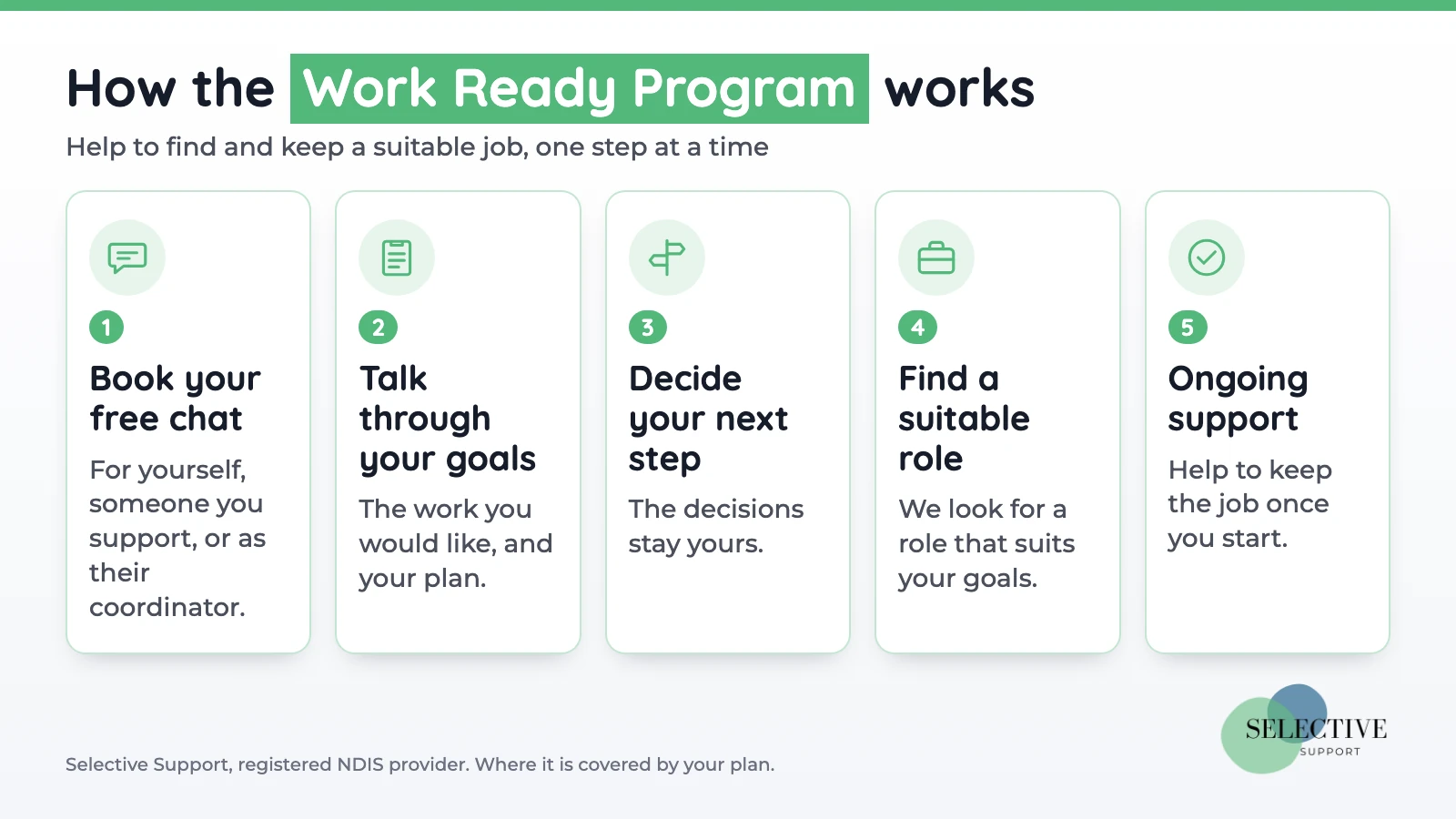
Selective Support is a registered NDIS provider, and we talk your plan through with you. Through our Work Ready Program, we help NDIS participants find and keep a suitable job, in a role and location that suits them. We can talk through employment support where it is covered by your plan.
Read more about the Work Ready Program, our NDIS supported employment, or book your free chat.