
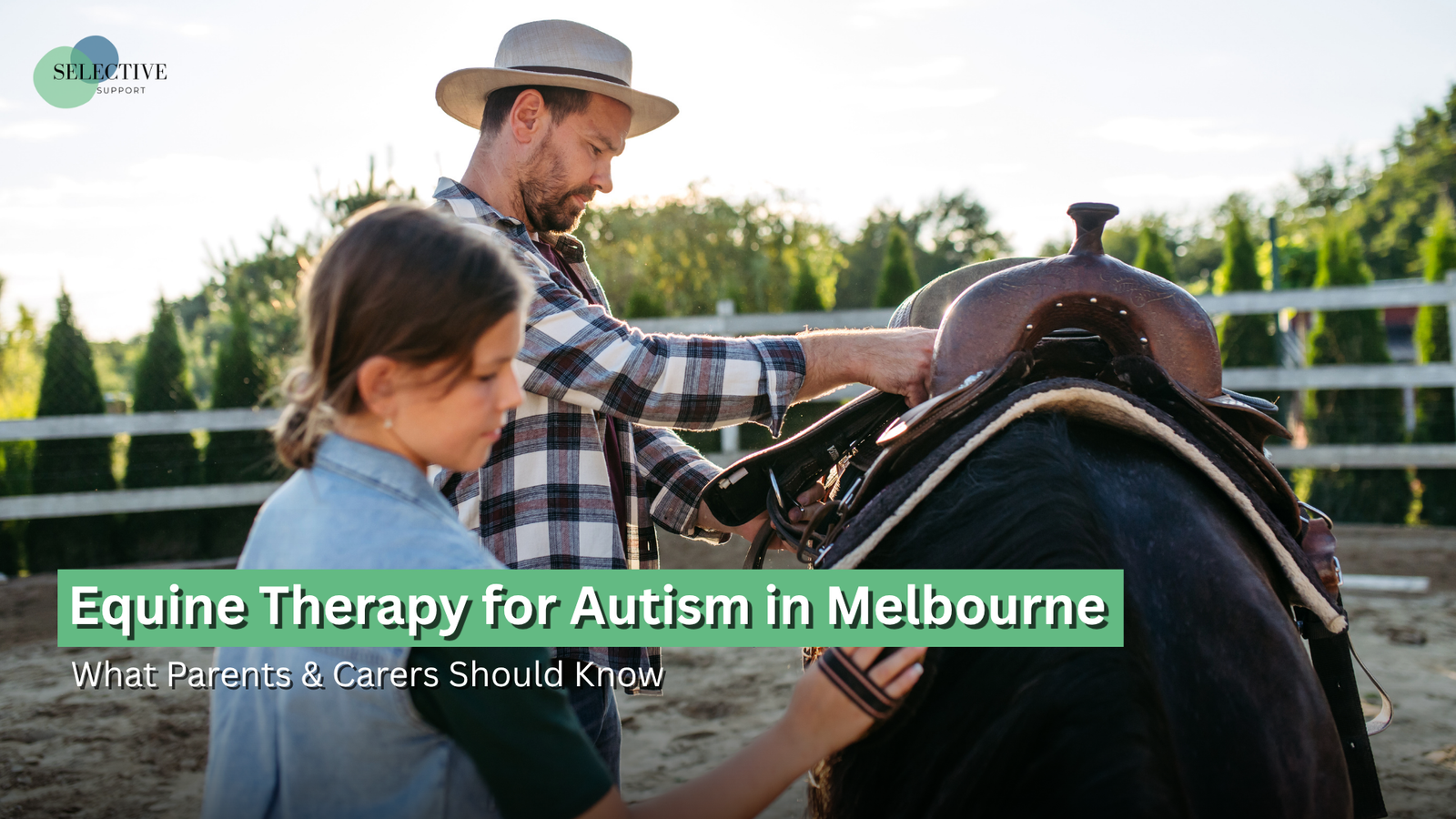
Equine Therapy for Autism in Melbourne: A Parent & Carer Guide
If you’re looking for a different way to support your autistic child, teenager or family member, equine-assisted therapy may have caught your attention.
Perhaps they enjoy animals or outdoor spaces. Maybe traditional clinic settings feel demanding. Or you may simply be wondering whether working alongside horses could support goals such as communication, emotional regulation, confidence or everyday independence.
Equine therapy for autism is not a cure, and it will not suit every autistic person. But for some participants, structured, ground-based activities with horses may offer an engaging environment in which to practise meaningful skills.
This guide explains what families can expect from equine therapy in Melbourne, what goals sessions may support, how individual sensory and communication needs can be considered, and how the service may fit within an NDIS plan.
If you want a deeper look at the research, read our guide Equine Therapy for Autism: What the Evidence Says.
What Can Equine Therapy for Autism Support?
Every autistic person is different. That means equine-assisted sessions should not start with a list of things autism supposedly needs to “fix”.
They should start with the participant’s own needs, strengths and goals.
Depending on the person, structured activities alongside a horse may provide opportunities to work towards goals involving:
- Emotional regulation
- Confidence
- Communication
- Following routines
- Decision-making
- Problem-solving
- Social interaction
- Everyday independence
- Community participation
For example, grooming a horse might be used to practise following a sequence of tasks. A simple ground-based activity may create opportunities to make choices, communicate preferences or ask for help.
For another participant, the focus might be on noticing when they need a break, practising strategies for staying regulated or becoming more comfortable with an unfamiliar routine.
Focus on Goals, Not “Fixing” Autism
The aim of equine therapy for autism should never be to make someone appear less autistic.
A meaningful goal is one that helps the participant live, communicate or participate in ways that matter to them.
One person may want to become more confident communicating their needs. Another may want to build independence with routines. Someone else may be working on managing transitions or participating more comfortably in community settings.
Progress should be measured against those individual goals rather than against an idea of what an autistic person “should” be like.
This is also consistent with the NDIS approach to goals. NDIS goals are chosen by the participant and may include building skills, independence, relationships or community participation.
What Does Equine Therapy in Melbourne Look Like for an Autistic Participant?
Starting a new support can feel uncertain for both the participant and their family.
Knowing what to expect can make the first step easier.
At Selective Support, equine-assisted sessions take place at our Diggers Rest property in Melbourne’s north-west. Sessions are fully ground-based, so participants are not expected to take part in mounted activities. They are led by an experienced developmental educator and shaped around the participant’s individual goals, communication needs and comfort level.
Activities may include:
1. Grooming or caring for a horse
This can provide opportunities to practise routines, sequencing, responsibility or communication.
2. Observing horse behaviour
Participants may notice movement, body language and changes in the environment.
3. Practising calm communication
Sessions can create opportunities to express choices, give instructions or communicate boundaries.
4. Completing a structured activity
A simple task may involve planning, problem-solving, patience or decision-making.
5. Building familiar routines
Repeating predictable parts of a session may help participants know what to expect and become more comfortable over time.
The horse is not the therapy by itself. Current NDIS guidance describes animal-assisted therapy as a professional therapy session where the animal is used as one tool to help the participant engage and work towards specific goals.
What Happens During the First Session?
There should be no expectation that a participant immediately approaches, touches or interacts closely with a horse.
The first session can include time to:
- Meet the practitioner
- Become familiar with the environment
- Observe the horses from a comfortable distance
- Discuss communication preferences
- Identify interests and goals
- Understand what future sessions might involve
Some participants may feel comfortable around horses quickly. Others may need several sessions to become familiar with the setting.
Both responses are valid.
A supportive practitioner should work at the participant’s pace rather than treating interaction with the horse as something that must happen immediately.

How Are Sensory and Communication Needs Supported?
Autistic participants can have very different sensory experiences.
An outdoor equine environment includes sounds, movement, smells, textures and changing weather conditions. Some people may enjoy these experiences, while others may find particular parts uncomfortable.
Before sessions begin, it can help to tell the practitioner about:
- Sensitivity to sounds
- Comfort with different textures or smells
- Preferred communication methods
- How much processing time is helpful
- Signs that the participant may need a break
- Whether predictable routines are important
- Any strong likes or dislikes
- How close they are comfortable being to animals
- What helps when something feels unfamiliar
Communication does not need to look the same for every participant.
Someone may use spoken language, gestures, AAC, visual supports or another communication method. A participant may also need extra time to process a question or prefer fewer verbal instructions at once.
The key principle is simple: the participant should not have to fit a standard session. The session should be adapted to the participant.
At Selective Support, ground-based activities can be adjusted according to the participant’s communication style, interests, comfort and pace.
Equine Therapy NDIS Funding for Autistic Participants
Having an autism diagnosis does not automatically mean equine-assisted therapy will be funded.
The NDIS looks at the actual support being provided, how it relates to the participant’s disability and goals, and whether it meets the relevant funding requirements.
Current NDIS guidance says animal-assisted therapy may be an NDIS support when it:
- Relates to the participant’s disability
- Is in line with their NDIS plan
- Represents value for money
- Meets applicable pricing requirements
- Is planned around specific goals
- Is delivered by a trained and qualified health professional
The NDIS also says therapy supports need evidence showing they are likely to help improve or maintain the participant’s skills and independence, and they must be delivered by appropriately qualified allied health professionals.
So instead of asking only:
“Does the NDIS fund equine therapy for autism?”
A more useful question is:
“Does this particular support match this participant’s disability-related needs, goals, available funding and professional recommendations?”
For more detail, read Is Equine Therapy Covered by the NDIS? and How to Get Equine Therapy Funded in Your NDIS Plan.
Funding is never guaranteed, so check your plan and speak with your support coordinator, plan manager or NDIS contact before committing funds.
How to Know Whether Equine Therapy Could Suit Your Child
You do not need to decide based only on whether your child “likes horses”.
Think about the wider environment, their goals and the type of support they prefer.
Consider these questions:
1. Are they comfortable around animals?
They do not need previous horse experience, but their comfort and interest should be respected.
2. Do they enjoy practical or outdoor activities?
Some participants engage more comfortably when they can learn through doing rather than sitting in a traditional consultation room.
3. Is there a clear goal to work towards?
The provider should be able to explain how activities connect to meaningful developmental or functional goals.
4. Can the environment accommodate their sensory needs?
Ask how the provider manages noise, proximity to horses, breaks, pace and transitions.
5. Can communication be adapted?
The participant should be able to communicate in the way that works best for them.
6. Is the practitioner appropriately qualified?
Their professional training should match the type of support being provided.
Equine-assisted therapy will not suit every autistic participant or every goal.
That is an important part of informed choice. A participant-first provider should be willing to explain honestly when another service or environment may be a better fit.
Equine Therapy for Autism in Melbourne FAQs
1. Is equine therapy good for autistic children?
It may help some autistic children work towards individual goals involving communication, regulation, confidence, routines or independence. Outcomes vary, so sessions should be personalised and progress reviewed over time.
2. Does equine therapy involve horse riding?
Not at Selective Support. Sessions are fully ground-based and may involve grooming, observation, communication, routines and structured problem-solving activities.
3. Can autistic adults access equine therapy?
Yes. Suitability depends on individual goals, preferences and support needs rather than age alone. Selective Support’s equine service welcomes children, teenagers and adults.
Exploring Equine Therapy in Melbourne? Start With a Conversation
You do not need to understand every NDIS funding category or know exactly what a session should look like before making an enquiry.
Start with the person.
What would they like to become more confident doing? What environment helps them feel comfortable? How do they communicate best? What everyday skill or goal would they like support with?
From there, you can explore whether equine-assisted therapy appears to be a suitable option.
Selective Support provides personalised, ground-based NDIS equine therapy in Melbourne at our Diggers Rest property, with sessions shaped around individual developmental and capacity-building goals.
Wondering whether equine therapy could suit your child or family member? Book a free chat and we’ll talk through their goals, preferences and support needs.