Is Equine Therapy Covered by the NDIS? (2026 Guide)
It’s one of the first questions families ask, and the honest answer is: it depends, and here’s exactly what it depends on.
Equine-assisted therapy may be funded through the NDIS when it is delivered as a genuine therapy support by a qualified professional. It must relate to the participant’s disability, support their individual goals and form part of an evidence-based treatment plan.
A general horse experience or recreational activity is treated differently. Calling an activity “equine therapy” does not automatically make it an NDIS-funded therapy support.
The NDIS explains:
“We only fund animal-assisted therapy if it’s considered reasonable and necessary.”
That distinction matters when you are deciding whether to book a provider, sign a service agreement or use funding from your plan.
This guide explains what may be funded, what is excluded and how to check whether equine-assisted therapy fits your particular NDIS plan.
Looking for local support? Learn more about our NDIS equine therapy in Melbourne and how the service may support your individual goals.
Will the NDIS Pay for Equine Therapy? The Short Answer
Equine-assisted therapy may be funded by the NDIS when a qualified allied health professional uses a horse as part of structured, goal-directed therapy.
For the support to be fundable, it generally needs to:
- Be related to the impact of your disability
- Align with the goals and funding in your NDIS plan
- Be delivered by a suitably qualified professional
- Use an evidence-based therapeutic approach
- Have clear goals and measurable outcomes
- Represent value for money
- Stay within the relevant NDIS price limit where one applies
The NDIS participant guidance states that animal-assisted therapy must be related to the participant’s disability, in line with their plan, value for money and below the applicable maximum hourly rate.
The horse does not become the funded support by itself. The NDIS is paying for the professional therapy service in which the horse is used as one therapeutic tool.
Recreational horse activities are not funded as therapy. The NDIS may sometimes fund additional disability support needed to take part in a community activity, such as assistance from a support worker, but it does not pay the ordinary cost of the recreational activity.
What the NDIS actually funds and what it doesn’t
The clearest way to assess NDIS equine therapy is to ask two questions:
- Who is delivering the support?
- What therapeutic outcome is the session designed to achieve?
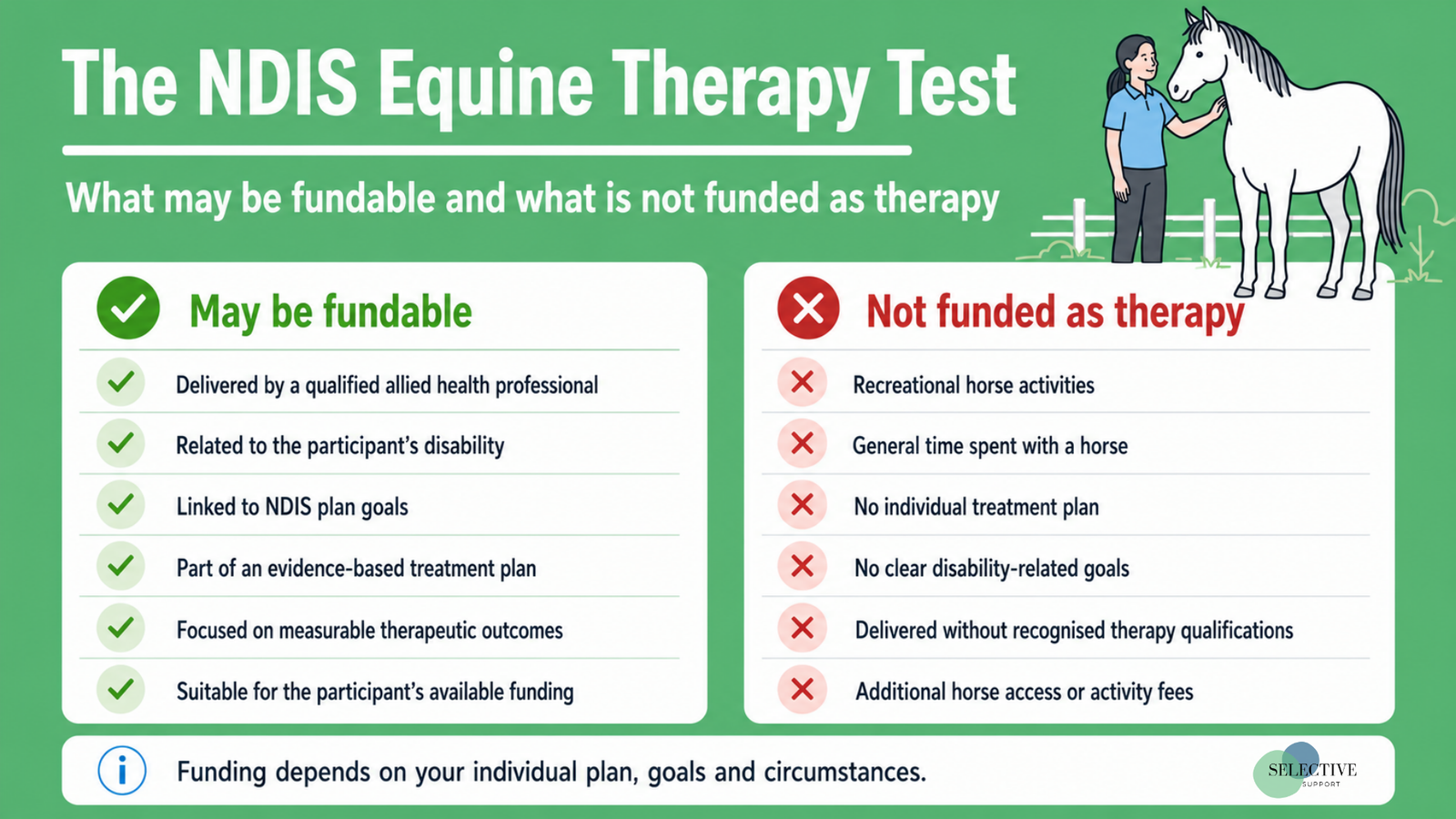
A fundable animal-assisted therapy session is planned around the participant’s goals. The professional should be able to explain:
- The disability-related need being addressed
- The therapeutic method being used
- Why including a horse supports engagement or progress
- What skills or functional outcomes the participant is working towards
- How progress will be measured
- How long the support is expected to be needed
The current NDIS guidance describes animal-assisted therapy as evidence-based treatment in which an animal helps the participant engage in a therapy session. It also says the therapy must be planned around the participant’s goals and provided by a trained and qualified health professional.
For example, a psychologist might include a horse in sessions focused on emotional regulation, communication or managing disability-related anxiety. An occupational therapist might use carefully structured interaction with a horse while working on functional abilities, coordination or participation.
In each case, the professional is delivering therapy within their recognised scope of practice. The horse supports the therapeutic process.
Why “animal therapy” is different from “animal-assisted therapy”
The terms sound similar, but the NDIS treats them differently.
Animal-assisted therapy is a structured professional service. It has therapeutic goals, an evidence-based approach and measurable outcomes.
Animal therapy can be a broad label used for an enjoyable or calming experience with an animal. It may feel beneficial, but that does not necessarily make it an NDIS therapy support.
The NDIS states:
“Animal therapy is not an NDIS support.”
Current NDIS therapy guidance also lists animal therapy among the supports that cannot be funded as therapy. It explains that even when a provider is an allied health professional, a support cannot be funded if there is not enough evidence that it will produce suitable functional outcomes for the participant’s disability.
Before booking, ask the provider:
- What recognised profession will the therapist be claiming under?
- What disability-related goals will the sessions address?
- Is there an individual treatment plan?
- How will progress and outcomes be documented?
- Does the quoted fee include an additional charge for access to the horse?
- Which NDIS support item will appear on the invoice?
These questions can help you identify whether you are purchasing professional therapy or a general horse-based experience.
Why recreational horse sessions are excluded
The NDIS specifically includes “riding a horse” in its examples of activities that are not animal-assisted therapy when they are recreational, sporting or social rather than goal-centred and evidence-based.
Having a professional present does not automatically change the nature of the service.
The session itself must be:
- Individually linked to the participant’s disability
- Delivered within the professional’s recognised therapeutic scope
- Part of an evidence-based treatment plan
- Focused on specific functional outcomes
- Documented and reviewed as therapy
This means the provider’s job title alone is not enough. The activity must genuinely form part of the therapeutic intervention.
Still unsure where the line is drawn? Read our guide to equine therapy vs therapeutic horse riding to understand what the NDIS may fund and what is generally excluded.
Who Can Deliver NDIS Equine Therapy?
When considering equine assisted therapy and NDIS funding, remember one simple principle:
The profession is what makes the service potentially fundable, not the horse.
The NDIS says:
“Only qualified and registered allied health professionals can deliver therapy supports.”
Depending on the participant’s needs and the type of therapy being delivered, a suitable professional may include:
- An occupational therapist
- A psychologist
- A counsellor who meets the relevant professional requirements
- A developmental educator
- A physiotherapist
- A social worker
- Another recognised allied health professional listed within current NDIS therapy guidance
The professional must be registered with the Australian Health Practitioner Regulation Agency where their profession is regulated, or accredited by the relevant peak body for a self-regulated profession. Providers who do not hold the required qualifications or professional registration cannot claim their services as NDIS therapy.
Equine experience or horse-handling qualifications may be valuable for safety and service quality, but they do not replace the allied health qualifications required to deliver an NDIS-funded therapy support.
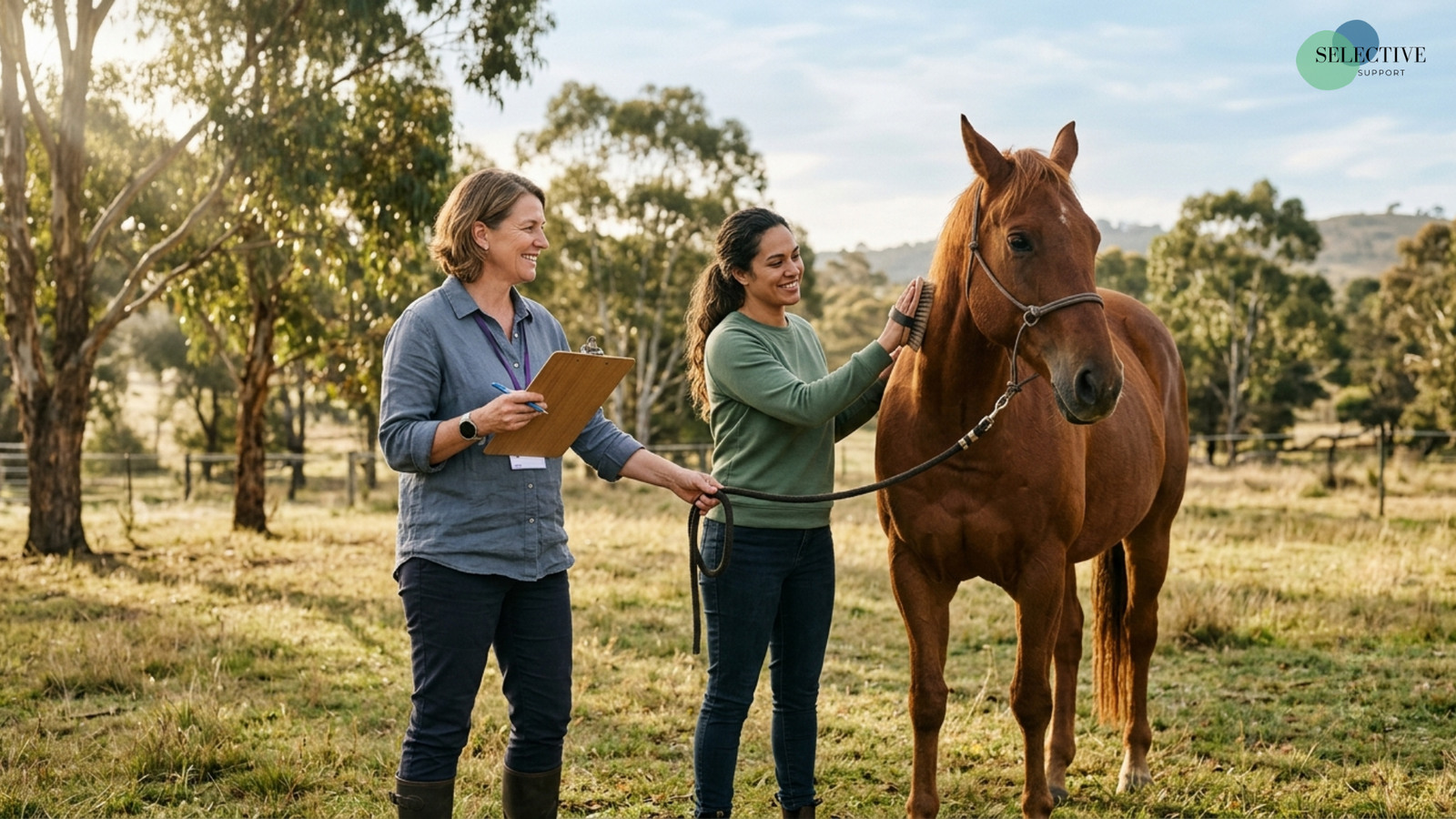
Ask to see the provider’s professional registration, membership or accreditation before agreeing to use plan funds.
How to know if Equine-Assisted therapy fits your plan
Even when a service meets the general definition of animal-assisted therapy, it must still fit the individual participant’s plan.
Start by checking four areas.
1. Does it relate to your disability?
The therapy should address a functional difficulty connected to your disability. This might involve communication, emotional regulation, social interaction, movement, decision-making or participation in everyday life.
Enjoying time with horses is not enough on its own. The provider should be able to explain the disability-related outcome being pursued.
2. Does it support your NDIS goals?
The link does not always need to include the words “equine therapy” in the goal itself. However, the therapy should clearly help you work towards a goal recorded in your plan.
For example, your goal may involve:
- Building emotional regulation skills
- Communicating more confidently
- Increasing independence
- Participating in the community
- Developing physical or functional abilities
- Managing disability-related anxiety in everyday situations
The NDIS makes reasonable and necessary decisions based on each participant’s circumstances, including their disability support needs and the assistance available from family, carers and community services. A support funded for one person is not automatically funded for another person with the same diagnosis.
3. Do you have the appropriate budget?
Therapy supports commonly sit within the Capacity Building budget, under Improved Daily Living.
The NDIS describes Improved Daily Living as funding for assessments, training and therapies that build living skills, independence and community involvement. Capacity Building categories are stated, so funding cannot simply be moved from an unrelated category to pay for therapy.
Check the exact wording in your plan. Some plans may include a specific stated therapy or outcome that limits how the funding can be used.
4. How is your funding managed?
Your management type affects which providers you can engage, but it does not change what counts as an NDIS support.
- Self-managed: You can generally use registered or unregistered providers and manage invoices and records yourself.
- Plan-managed: Your plan manager pays invoices, and you can generally choose registered or unregistered providers.
- NDIA-managed: The provider must be registered with the NDIS Quality and Safeguards Commission.
No matter how the plan is managed, funding can only be spent on NDIS supports that are in line with the participant’s plan.
This is where a support coordinator can help. They can review the relevant budget, compare the service with your goals, check the provider’s credentials and help you understand what evidence may be needed before you commit funds.
Selective Support’s approach is centred on helping participants and families understand their options, make informed choices and feel more confident using their NDIS plans.
How to Request Equine Assisted Therapy in Your NDIS Plan
Thinking equine-assisted therapy could help is a good starting point, but the NDIA will usually need clear evidence showing how it relates to your disability and NDIS goals.
This may include:
- A recommendation from a qualified allied health professional
- The goals and outcomes the therapy will support
- How often the therapy is needed
- How progress will be measured
- Why the support is considered suitable and value for money
Before using your funding, check the provider’s qualifications, ask for a clear service proposal and speak with your support coordinator, plan manager or NDIS contact.
For a step-by-step guide, read How to Get Equine Therapy Funded in Your NDIS Plan.
Equine Therapy and NDIS Funding FAQs
1. Is equine therapy still covered by the NDIS in 2026?
Equine-assisted therapy may be funded when it is delivered by a qualified professional, relates to your disability and supports your NDIS goals. It is not automatically covered.
2. Will the NDIS pay for horse riding?
The NDIS does not fund recreational horse riding as therapy. It may fund additional disability support needed to take part in an eligible community activity.
3. Who has to deliver equine-assisted therapy for it to be funded?
It must be delivered by a suitably qualified and registered or accredited allied health professional, such as an occupational therapist, psychologist or developmental educator.
4. Is equine-assisted therapy covered for autism?
It may be funded for an autistic participant when it meets the NDIS criteria and supports their individual disability-related needs and goals.
5. How do I check whether it is covered by my plan?
Check your Capacity Building or Improved Daily Living funding, then confirm the provider’s qualifications, treatment goals, pricing and support item. Speak with your support coordinator, plan manager or NDIS contact before using your funding.
Still unsure whether equine therapy fits your NDIS plan?
You should not have to guess whether a support is appropriate or worry that you are using the wrong part of your plan.
That is exactly what we help with.
Selective Support can talk through your goals, review the relevant funding and help you prepare the right questions for the provider. We cannot guarantee that a support will be funded, but we can help you make a clearer, more informed decision.
Not sure if equine therapy fits your NDIS plan? Book a free chat and we’ll help you check.