Questions to Ask an Equine Therapy Provider Before You Book
Choosing an equine therapy provider can feel like a big decision, especially when you are using NDIS funding and want to know that the service is safe, appropriate and genuinely connected to your goals.
A beautiful property and calm horses can make a positive first impression. But before you book, there are more important things to check.
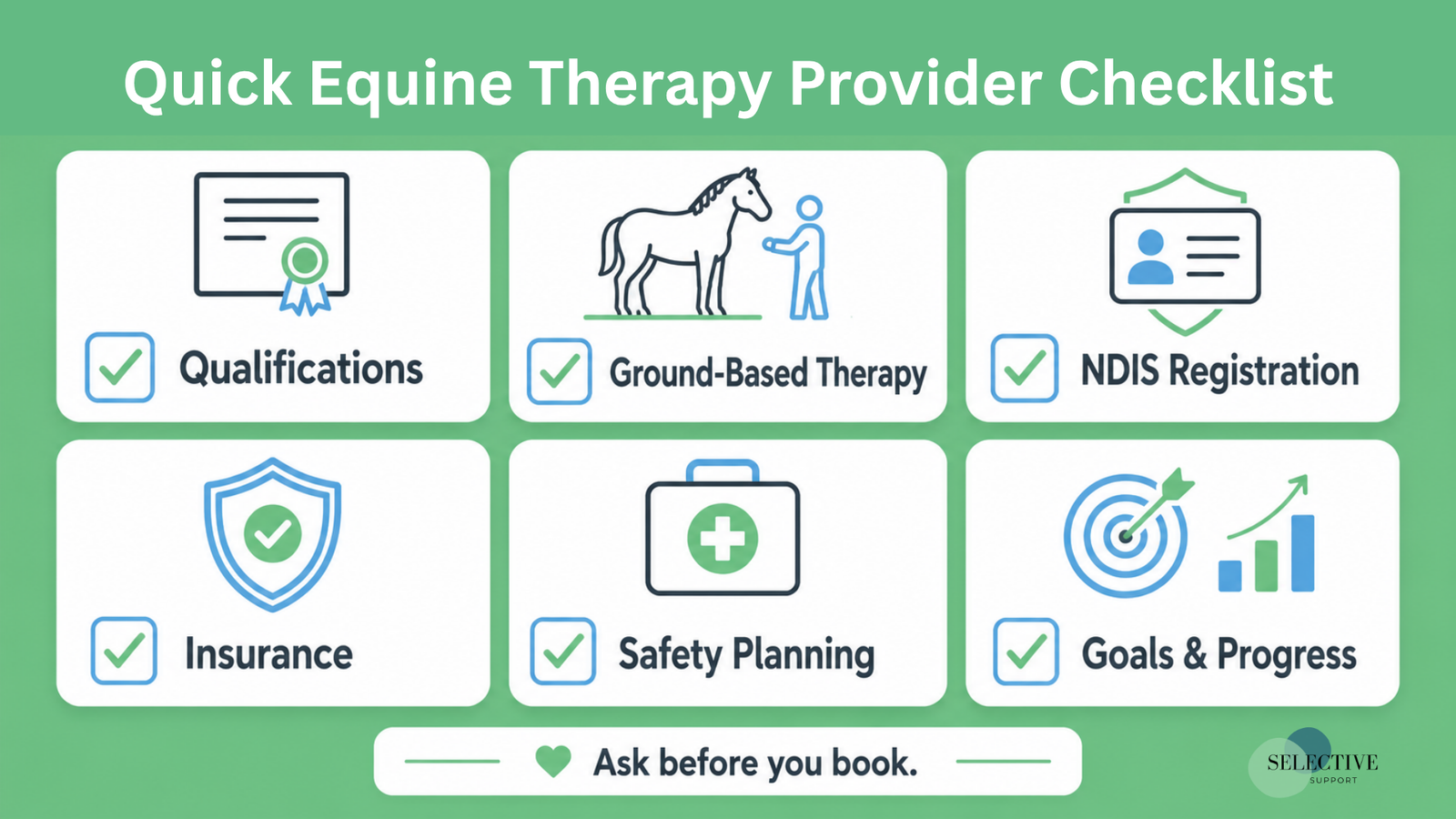
The right questions can help you understand:
- Who will actually deliver the sessions
- What qualifications they hold
- Whether the support is therapy, learning or recreation
- How safety is managed
- How your NDIS goals will be used
- What will appear on your invoices
- How progress will be measured
Current NDIS guidance makes an important distinction: animal-assisted therapy must be planned around individual goals and delivered by a trained and qualified health professional. The animal is used as one tool within the professional therapy session.
How to Choose Equine Therapy: Start With Qualifications
One of the first questions to ask an equine therapy provider is:
“What professional qualification does the person delivering my sessions hold?”
Do not rely only on titles such as “equine therapist”, “horse facilitator” or “equine practitioner”. Ask about the practitioner’s underlying profession.
Depending on the service being offered, this might include:
- Developmental education
- Psychology
- Occupational therapy
- Counselling
- Social work
- Physiotherapy
- Another recognised allied health profession
Current NDIS guidance says therapy supports must be delivered by appropriately qualified allied health professionals who are registered with Ahpra or accredited by the relevant peak body for a self-regulated profession. Developmental education is among the professions recognised within NDIS therapy supports.
Useful questions include:
- What is your primary professional qualification?
- Are you registered or accredited with the relevant professional body?
- What equine-specific training have you completed?
- Do you have experience supporting people with needs similar to mine?
- Is the service being delivered within your professional scope?
The practitioner’s professional qualifications matter because the horse itself does not make a session therapy.
Is It Equine-Assisted Therapy or a Recreational Horse Activity?
Horse-based services can use similar language while offering very different things.
Ask the provider to clearly explain what happens during a session and what the participant is working towards.
Under NDIS guidance, animal-assisted therapy is goal-centred, forms part of evidence-based treatment and is delivered by a qualified health professional. Recreational, sporting or social horse activities are treated differently and cannot simply be claimed as therapy.
Ask:
- Are sessions ground-based?
- What disability-related goal will we be working towards?
- Is there an individual therapy or developmental plan?
- How does each activity connect to that goal?
- How is the service different from a recreational horse activity?
At Selective Support, equine-assisted sessions are fully ground-based. Activities may include grooming, observing horse behaviour, practising calm communication and completing structured problem-solving tasks. Sessions are connected to individual developmental and capacity-building goals.
For a detailed explanation of the funding distinction, read Equine Therapy vs Therapeutic Horse Riding: What the NDIS Funds.
Is Your Equine Therapy Provider NDIS Registered and Insured?
Another common question is: does an equine therapy provider need to be NDIS registered?
It depends on how your funding is managed.
If your support is NDIA-managed, you must use a registered NDIS provider.
If your funding is plan-managed or self-managed, you can usually use either registered or unregistered providers, although some specific NDIS supports still require registered providers.
Both registered and unregistered providers delivering NDIS supports must follow the NDIS Code of Conduct.
Before booking, ask:
- Are you an NDIS registered provider?
- Can you explain which support item you intend to invoice?
- Do you hold current public liability insurance?
- Do you hold professional indemnity insurance?
- Does your insurance appropriately cover the services and animal-involved activities you provide?
- Can I see the service agreement before committing?
Insurance is particularly worth discussing when sessions take place around large animals and on a rural property.
You should feel comfortable asking for clear answers in writing.
What Safety Questions Should You Ask?
Feeling comfortable around the practitioner is important, but you also need to understand how they manage safety.
Equine environments introduce considerations that may not exist in a traditional consulting room.
Ask the provider:
- How do you decide which horse is appropriate for each participant?
- What training does the practitioner have in horse handling and behaviour?
- How do you assess a participant before activities begin?
- What happens if someone becomes overwhelmed or uncomfortable?
- What is the emergency plan for the property?
- How are weather, animals and environmental risks managed?
- Are relevant workers appropriately screened?
For registered NDIS providers, workers in risk-assessed roles generally require NDIS Worker Screening clearances. The NDIS Quality and Safeguards Commission says registered providers are responsible for identifying risk-assessed roles and maintaining the appropriate records.
You can also ask about practical considerations such as:
- Accessible toilets and parking
- Shade and weather arrangements
- First-aid procedures
- Emergency access
- Sensory needs
- Communication preferences
- What clothing or footwear is recommended
A good provider should be able to explain safety procedures calmly and clearly without making you feel difficult for asking.
Your Equine Therapy Checklist for Goals and Reporting
A session may be enjoyable, but if you are purchasing a therapeutic or capacity-building support, you should also know what you are working towards.
Ask:
“How will you connect these sessions to my NDIS goals?”
The provider should be able to explain the link between an activity and a functional outcome.
For example, grooming a horse might form part of working on:
- Following a routine
- Sequencing tasks
- Communication
- Responsibility
- Emotional regulation
- Independence
The activity should have a purpose beyond simply spending time with a horse.
NDIS therapy guidance says appropriate therapy supports should have goals, outcomes and evidence showing they are likely to improve or maintain skills and independence.
Also ask:
- How are goals agreed at the beginning?
- Do you document progress?
- How often are goals reviewed?
- Can you provide progress information when needed?
- How will you know if the sessions are helping?
- What happens if progress is limited?
- Can information be shared with my support coordinator or other treating professionals with my consent?
Clear reporting can be particularly important when preparing for a plan review or deciding whether to continue using funding on a particular support.
For a broader explanation of when equine-assisted therapy may be an NDIS support, read Is Equine Therapy Covered by the NDIS?.
Getting Started With an Equine Therapy Provider
Before committing to regular sessions, ask what the first few steps look like.
A good starting conversation should give you space to explain your goals and ask questions without pressure.
Check:
- Is there an initial consultation?
- Is there a cost for the first conversation?
- Is there currently a waitlist?
- Where are sessions held?
- How long are sessions?
- What happens before the first appointment?
- Can a family member or carer be involved where appropriate?
- What are the cancellation terms?
Selective Support offers a free initial chat to discuss the participant’s interests, needs and NDIS goals before sessions begin.
Ground-based sessions are held at 315 Bulla Diggers Rest Road, Diggers Rest VIC 3427, in Melbourne’s north-west. They are led by an experienced developmental educator and adapted to the participant’s communication needs, comfort level and pace.
You can learn more about our NDIS equine therapy in Melbourne before deciding whether the service may suit your goals.
Equine Therapy Provider FAQs
1. How do I know if an equine therapy provider is legitimate?
Ask about their professional qualifications, registration or accreditation, insurance, safety procedures and how sessions connect to individual goals. They should be willing to explain exactly what service they provide and who delivers it.
2. Does an equine therapy provider need to be NDIS registered?
It depends on your funding management. NDIA-managed funding requires registered providers. Plan-managed and self-managed participants can usually use registered or unregistered providers, subject to the rules for the particular support.
3. What qualifications should an equine therapy practitioner have?
For an NDIS therapy support, the practitioner should hold appropriate qualifications in a recognised allied health profession and be registered with Ahpra or accredited by the relevant professional body. Their qualifications should match the service they are delivering.
Ask Questions Before You Commit Your Plan Funds
You do not need to choose a provider based on a website, a program name or how comfortable the property looks.
Ask who is delivering the service. Check their qualifications. Understand the goals, safety procedures, invoices and reporting. Most importantly, make sure the service is designed around what you want to work towards.
A provider who puts participants first should welcome those questions.
Have these questions ready? Ask us all of them, book a free chat.