EAP vs EAL vs Equine-Assisted Therapy: Who Delivers What?
You have found a provider offering support with horses, but the service description includes several unfamiliar terms.
Is it equine-assisted learning? Equine-assisted therapy? Equine assisted psychotherapy?
The names are often used interchangeably, but they do not mean the same thing. Each approach has a different purpose, and the person delivering it should have qualifications that match the support being provided.
That distinction is especially important when you are using an NDIS plan.
The NDIS does not assess a service based only on the word “equine”. It looks at the actual support, the participant’s goals, the evidence behind it and the professional delivering it. Official guidance says animal-assisted therapy must be planned around individual goals and provided by a trained and qualified health professional. The animal is used as a tool within the therapy session.
This guide explains the difference between EAP and EAL, what developmental equine-assisted therapy means and how to work out which approach may suit you or someone you care for.
What Is Equine-Assisted Learning?
Equine-assisted learning, commonly shortened to EAL, is generally a structured learning or skill-building approach rather than mental-health treatment.
Participants take part in planned activities involving horses to practise or explore skills such as:
- Confidence
- Communication
- Problem-solving
- Teamwork
- Boundaries
- Leadership
- Emotional awareness
- Social interaction
- Decision-making
The focus is on learning through experience.
For example, a participant may work through an activity that requires planning, clear communication and responding to what is happening around them. The facilitator then helps the participant reflect on what they noticed and how the skills may apply in everyday life.
International EAL professional guidance describes these programs as experiential education that may be delivered by educators, coaches, professional-development trainers and other trained facilitators.
Who can deliver EAL?
Because EAL is not automatically a clinical therapy, the qualifications required can depend on the program, participant and outcomes being offered.
A facilitator should still have appropriate:
- EAL-specific education or training
- Experience working with the participant group
- Understanding of disability and communication needs
- Professional insurance
- Safety and risk-management procedures
- Training in horse behaviour and welfare
- Clear boundaries around what they are qualified to provide
For NDIS participants, it is also important to check the facilitator’s underlying profession.
A developmental educator, for example, may use experiential activities to support disability-related skill development where this falls within their professional scope. Developmental educators work in areas including collaborative goal-setting, evidence-based skill instruction, social participation, daily-living skills and capacity building.
However, EAL should not be presented as psychotherapy unless it is being delivered as a genuine mental-health treatment by an appropriately qualified mental-health clinician.
Equine-Assisted Therapy Meaning: Developmental Support
The equine-assisted therapy meaning can vary between providers, which is why families should look beyond the name.
In this guide, developmental equine-assisted therapy means a goal-linked therapeutic or developmental support in which a qualified professional includes a horse as one tool within their established practice.
The goal might involve:
- Building daily-living skills
- Improving communication
- Developing social participation
- Increasing independence
- Practising emotional regulation
- Building planning and problem-solving abilities
- Improving attention or engagement
- Working towards functional NDIS goals
The session should have an individual purpose. It should not simply be described as therapeutic because spending time near a horse feels calming or enjoyable.
The NDIS describes animal-assisted therapy as evidence-based treatment in which an animal helps a participant engage in a therapy session and work towards specific goals. It also says only qualified and registered or appropriately accredited allied health professionals can deliver NDIS therapy supports.
Who delivers developmental equine-assisted therapy?
The appropriate professional depends on the goal being addressed.
It may be delivered by a recognised therapeutic-support professional such as a:
- Developmental educator
- Occupational therapist
- Psychologist
- Counsellor who meets relevant professional requirements
- Social worker
- Physiotherapist
- Other suitably qualified allied health practitioner
A developmental educator may work on disability-related development, inclusion, social skills, daily-living abilities and capacity-building outcomes. Developmental education is recognised within current NDIS therapy-support guidance, and Developmental Educators Australia describes the profession as a self-regulated allied health profession.
The professional must still work within their own qualifications and scope.
For example, a developmental educator can provide developmental education and disability-related skill-building. They cannot call that work psychotherapy unless they also hold the separate qualifications and registration required to provide psychological treatment.
What Is Equine Assisted Psychotherapy?
Equine assisted psychotherapy, or EAP, is a mental-health treatment.
It may use structured interaction with horses to help a person explore thoughts, emotional responses, relationships or patterns of behaviour as part of a psychological treatment plan.
Possible areas of focus may include:
- Anxiety
- Trauma-related experiences
- Emotional regulation
- Relationships
- Self-esteem
- Stress
- Behavioural patterns
- Mental-health recovery
The important word is psychotherapy.
EAP is not simply a confidence-building activity with a horse. It involves clinical mental-health treatment, assessment, therapeutic boundaries and an appropriate treatment plan.
Some established EAP models use a team that includes a credentialled mental-health professional and an equine specialist. The mental-health professional remains responsible for the clinical treatment being delivered.
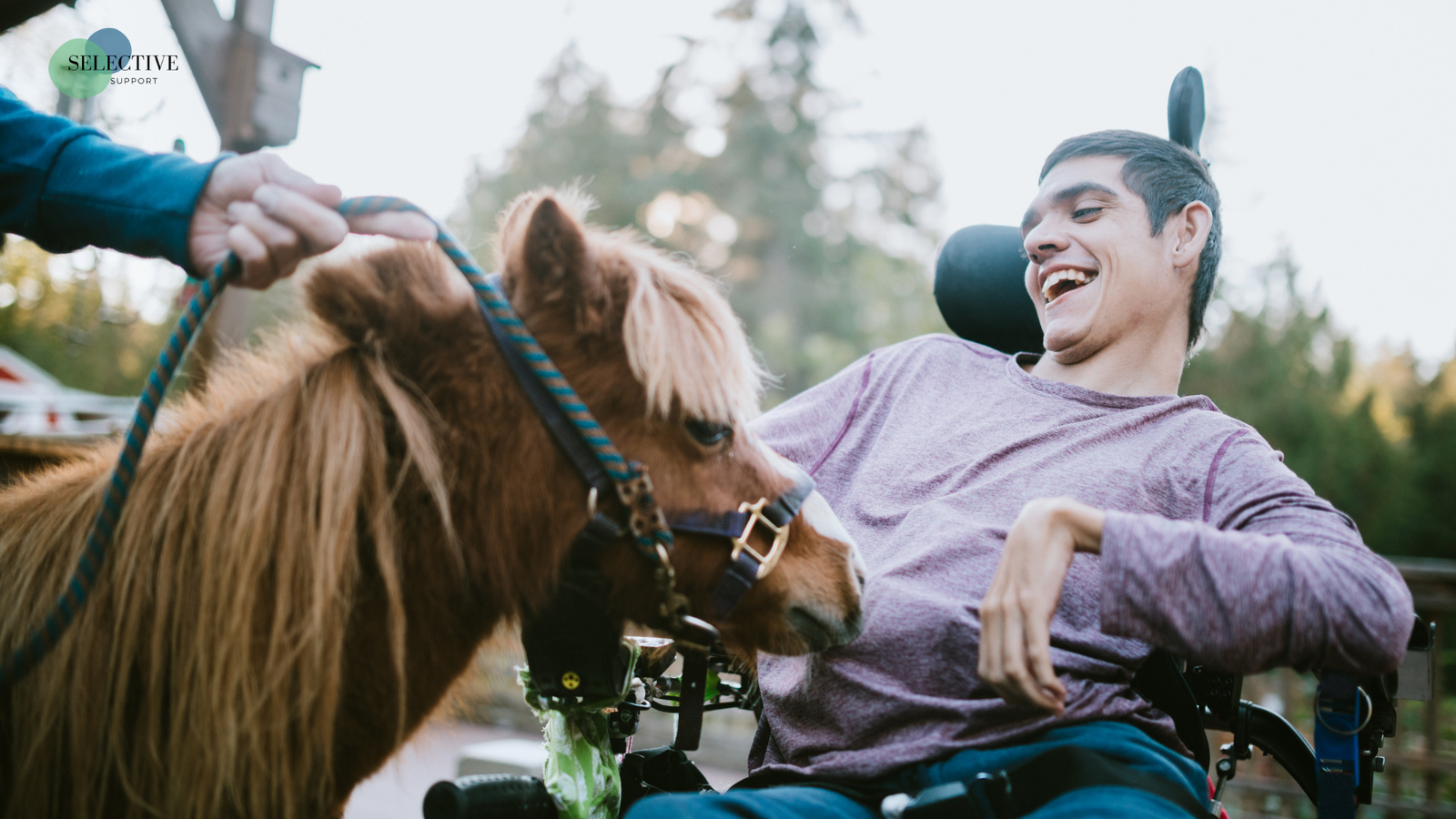
Who can deliver equine assisted psychotherapy?
At Selective Support, equine assisted psychotherapy is delivered only through a registered psychologist when it is clinically indicated.
Psychology is a regulated profession in Australia. A practitioner using the protected title “psychologist” must hold the appropriate registration through the Psychology Board of Australia and Ahpra.
A developmental educator does not deliver psychotherapy by virtue of being a developmental educator.
They may support disability-related learning, capacity building, participation and functional development. They must not diagnose mental-health conditions or provide psychological treatment unless they are separately qualified and registered to do so.
This clear separation protects participants and helps families understand exactly what type of service they are receiving.
The Difference Between EAP and EAL at a Glance
The easiest way to understand the difference is to start with the intended outcome.
Choose EAL when the main goal is learning
EAL may be relevant when the participant wants to work on:
- Confidence
- Communication
- Teamwork
- Leadership
- Problem-solving
- Social interaction
- Personal development
It is primarily educational or developmental, not psychotherapy.
Choose developmental equine-assisted therapy for functional goals
This approach may suit a participant working towards disability-related outcomes such as:
- Daily-living skills
- Independence
- Community participation
- Functional communication
- Developmental abilities
- Emotional regulation as a functional skill
- NDIS capacity-building goals
The practitioner’s recognised profession should match the outcome being addressed.
Choose EAP when the goal involves psychological treatment
EAP may be appropriate when a person requires clinical support for:
- Anxiety
- Trauma
- Mental-health symptoms
- Significant emotional distress
- Psychological patterns affecting daily life
A registered psychologist should assess whether this treatment is appropriate.
Which Equine Approach Is Right for You?
Feeling uncertain at this stage is understandable. Families are often given a service name before anyone has clearly explained what the sessions will involve.
Before choosing a service, it also helps to understand how the NDIS assesses equine-assisted supports. Read Is Equine Therapy Covered by the NDIS? for a clear explanation of what may be funded, what is generally excluded and what to check in your plan.
Start with these four questions:
- What outcome are we trying to achieve?
Is the main goal learning, functional skill development or mental-health treatment?2 - Who is delivering the service?
Ask about their primary profession, registration, accreditation and equine-specific training. - Is the support within that professional’s scope?
A course in equine facilitation does not replace allied health or psychology qualifications. - How will progress be measured?
The provider should be able to explain the goals, session approach and expected outcomes.
For autistic participants, the right approach will depend on individual strengths, needs and goals rather than diagnosis alone. Our guide to equine therapy for autism explores this in more detail.
How Equine Support Works at Selective Support
When you are comparing equine services, you deserve to know who is delivering the support, what they are qualified to provide and how each session connects to your goals.
At Selective Support, sessions are held at our Diggers Rest property in Melbourne’s north-west and are fully ground-based, with no horse-riding experience required. Activities are adapted to the participant’s communication style, comfort level, interests and NDIS goals.
Our approach includes:
- Equine-assisted learning, focused on practical skills such as confidence, communication, patience, teamwork and problem-solving.
- Developmental equine-assisted therapy, led by an experienced developmental educator and linked to goals such as emotional regulation, daily-living skills, social participation and independence.
- Equine assisted psychotherapy, available through a registered psychologist when clinical mental-health treatment is appropriate.
- Clear professional boundaries. A developmental educator does not provide psychotherapy or present developmental support as psychological treatment.
Sessions may include grooming, observing horse behaviour, practising calm communication or completing structured problem-solving activities. Each activity is chosen for a purpose and connected to the outcomes the participant wants to work towards.
You can learn more about our NDIS equine therapy in Melbourne and how sessions work at Diggers Rest.
EAP, EAL and Equine-Assisted Therapy FAQs
1. Is EAL the same as therapy?
No. EAL is generally focused on experiential learning and skill development. It should not be described as psychotherapy unless a suitably qualified mental-health clinician is providing psychological treatment.
2. Can a developmental educator deliver psychotherapy?
No, not based on developmental education qualifications alone. At Selective Support, psychotherapy is delivered through a registered psychologist. A developmental educator focuses on disability-related development, skills, participation and capacity building.
3. Which approach is funded by the NDIS?
Any funding decision depends on the participant’s goals, disability-related needs, plan and evidence. The service must also be delivered by a professional whose qualifications match the support being provided. No approach is automatically funded.
4. Which approach might help with autism?
EAL or developmental equine-assisted therapy may be considered for functional goals such as communication, confidence or daily-living skills. EAP may be considered where a registered psychologist identifies a need for psychological treatment, such as support with clinical anxiety.
5. Which approach might help with anxiety?
It depends on the nature of the anxiety. Skill-building support may help with emotional regulation, while significant or diagnosed anxiety may require assessment and treatment from a registered psychologist.
Find the Support That Matches Your Goals
Choosing between EAL, developmental therapy and EAP becomes easier when you stop focusing on the label and start with the outcome.
Ask what the sessions are designed to achieve. Then check whether the practitioner’s profession, experience and scope match that goal.
You do not need to work it out alone.
Not sure whether you need EAL, therapy or EAP? Book a free chat and we’ll point you the right way.