
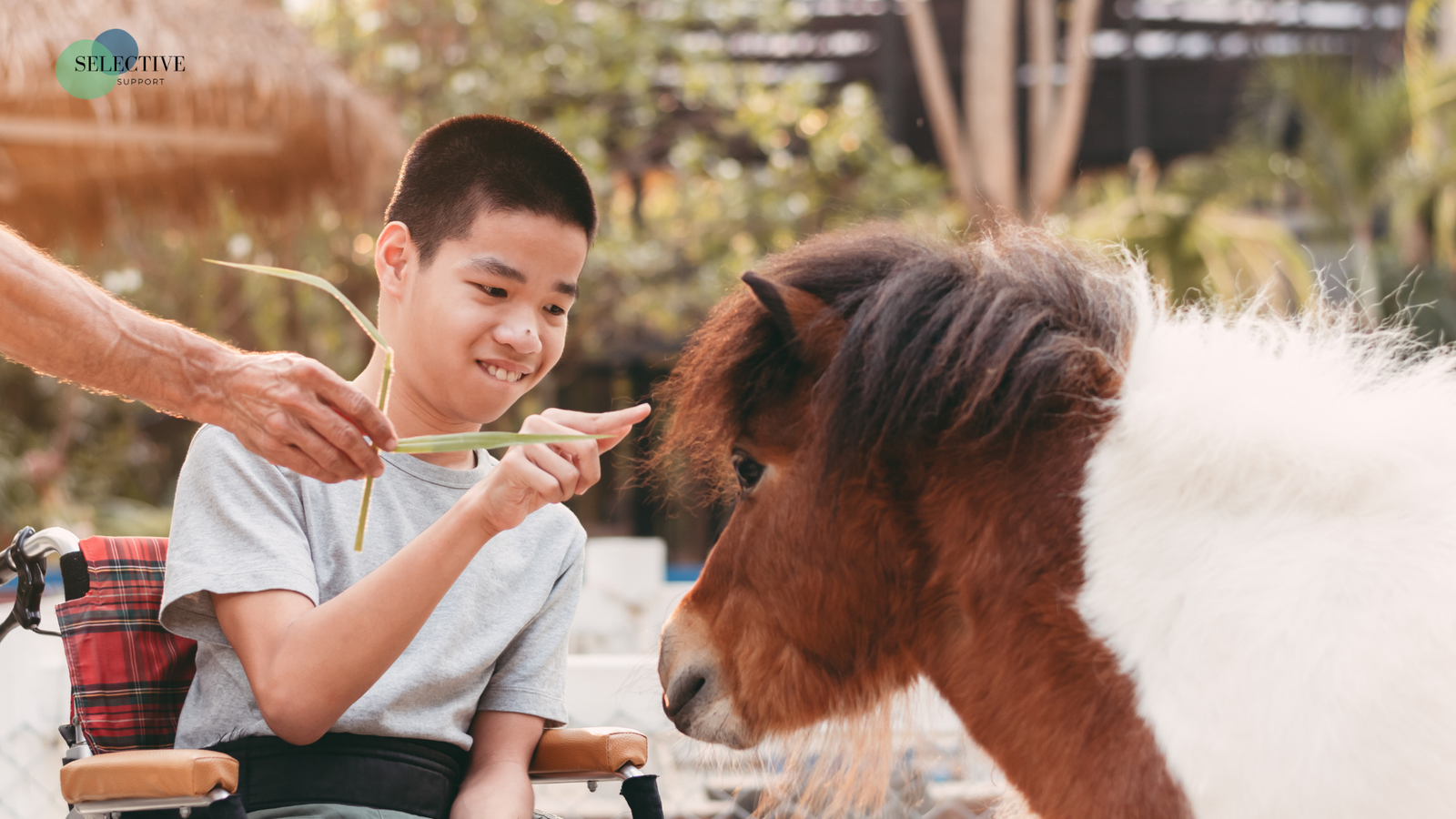
Feel calmer, build confidence and work towards your NDIS goals through meaningful, ground-based activities with horses.
Selective Support provides equine-assisted therapy and learning at our Diggers Rest property in Melbourne’s north-west. Sessions are led by an experienced developmental educator and shaped around the goals that matter to you.
You will work alongside our horses at your own pace in a calm, supportive environment.
For many NDIS participants and families, spending time with horses offers something that can be difficult to find in a clinic room.
Horses can help people slow down, stay present and practise new skills without pressure or judgement. With guidance from the right practitioner, these experiences can support confidence, emotional regulation, communication and everyday independence.
At Selective Support, every session is ground-based, goal-focused and built around your individual needs.
We also understand that knowing how a service fits within an NDIS plan can feel confusing. Because our team has a support coordination background, we can explain the process clearly and help you explore whether equine therapy is suitable for your goals and funding.
Equine-assisted therapy uses structured, ground-based activities with horses to support therapeutic, developmental and capacity-building goals.
Depending on the participant, activities may include:
The focus is on the relationship between the participant, the horse and the practitioner. Each activity gives the participant an opportunity to practise useful skills in a safe and practical way.
Horses are sensitive to movement, energy and communication. They often respond immediately to what is happening around them. This can give participants clear, judgement-free feedback while they practise patience, boundaries, emotional awareness and self-regulation.
Our developmental educator connects each activity to the participant’s NDIS goals, helping make sessions purposeful as well as enjoyable.
You may see the terms equine-assisted learning, equine-assisted therapy and equine-assisted psychotherapy used online. They are related, but they are not the same service.
Understanding the difference can help you choose the right support.
Equine Assisted Learning, often called EAL, focuses on personal and practical skill development.
Sessions may support:
At Selective Support, EAL sessions are delivered by our experienced developmental educator and may be suitable for participants working towards developmental, social or capacity-building goals.
Our developmental equine-assisted therapy sessions connect structured horse activities with therapeutic and daily-living outcomes.
This may include working towards greater independence, emotional regulation, communication or community participation.
Sessions are led by a developmental educator and are planned around the participant’s individual goals rather than using the same program for everyone.
Equine Assisted Psychotherapy, or EAP, is a mental health treatment that must be delivered within the appropriate clinical scope.
Where a participant needs clinical psychological treatment, EAP is delivered by a registered psychologist. We do not present developmental equine sessions as psychological treatment.
Still unsure how these approaches differ? Read our guide to EAP vs EAL vs equine-assisted therapy to understand who delivers each service and what type of support may suit your needs.
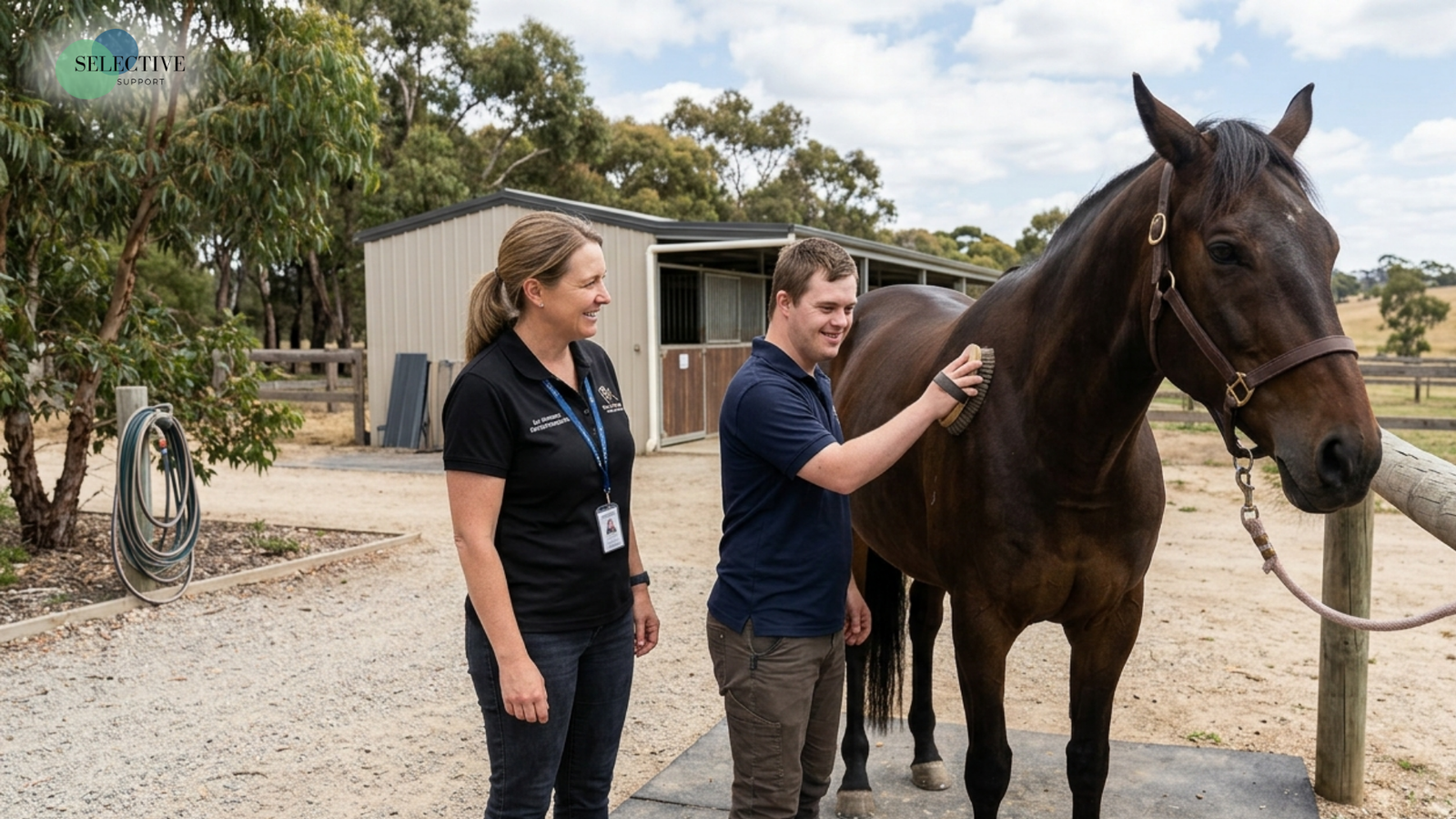
Our equine therapy Melbourne sessions welcome children, teenagers and adults with a range of needs, experiences and NDIS goals.
They may be suitable for participants living with:
Ground-based horse activities can provide a structured and engaging way to practise communication, sensory regulation, confidence and connection.
To learn more about how equine therapy may support autistic participants, read Equine Therapy for Autism: What the Evidence Says.
The calm pace of the environment may help participants practise grounding, emotional awareness and self-regulation without the pressure of a traditional clinical setting.
Sessions can support participants to build routine, motivation, confidence and meaningful engagement while working towards personal recovery goals.
Participants may work on patience, communication, teamwork, following instructions, problem-solving and independent decision-making.
We focus on the person and their goals, not simply a diagnosis.
Equine therapy will not suit every participant or every goal. We will always speak honestly with you about whether our service appears to be a helpful and appropriate fit.
Equine-assisted therapy may be funded through the NDIS when it is delivered by an appropriately qualified practitioner and relates directly to the participant’s goals.
It may be considered as a therapeutic or capacity-building support where the service is reasonable, necessary and appropriate for the person’s individual circumstances.
For a clearer overview of eligibility and funding considerations, read Is Equine Therapy Covered by the NDIS?.
Our sessions are led by a developmental educator and structured around measurable developmental or daily-living outcomes. They will generally be most relevant for plan-managed and self-managed participants, depending on the available funding and the way the plan is structured.
Every NDIS plan is different. We cannot guarantee that equine therapy will be funded under a particular plan.
What we can do is:
Our experience in support coordination means we understand the importance of connecting a service to clear goals and outcomes.
If you are preparing for a plan review, our guide on how to get equine therapy funded in your NDIS plan explains the steps and information that may help.
Starting a new service can feel uncertain. We make the process clear and take things one step at a time.
We begin by listening.
You can tell us about the participant, their interests, their NDIS goals and what they would like support with. We will explain how the sessions work and answer your questions.
Before sessions begin, we identify the skills or outcomes you would like to work towards.
This helps ensure activities are connected to meaningful NDIS goals rather than simply spending time with a horse.
Sessions take place at our Diggers Rest property with our horses and developmental educator.
Activities are adjusted to the participant’s comfort, communication needs and pace. No previous experience with horses is required.
We review how the participant is progressing and consider whether the sessions remain appropriate for their goals.
Progress is explained in clear language that participants, families and relevant NDIS professionals can understand.
Sessions are held at:
315 Bulla Diggers Rest Road
Diggers Rest VIC 3427
Our property is located on the edge of Melbourne’s north-west and is accessible from surrounding areas including Sunbury, Melton, Gisborne and greater north-west Melbourne.
Choosing an NDIS provider is a personal decision. You deserve to understand who is delivering the service, how it supports your goals and what you can expect.
It may be funded when delivered by a qualified practitioner and linked to your NDIS goals. Funding depends on your individual plan.
Sessions are led by an experienced developmental educator. Equine Assisted Psychotherapy must be delivered by a registered psychologist.
No. All sessions are ground-based, with no riding required.
Sessions may support confidence, communication, emotional regulation, social skills and everyday independence. Children, teens and adults are all welcome.
Sessions are held at 315 Bulla Diggers Rest Road, Diggers Rest VIC 3427, serving Melbourne’s north-west and surrounding areas.
The easiest first step is a free, no-pressure chat. Call 1800 845 233 or enquire online, and we’ll talk through your goals.
You do not need to understand every NDIS funding category before speaking with us.
Tell us what you would like to work towards, and we will explain how our ground-based equine sessions may support your goals.