Equine Therapy for Autism: What the Evidence Says
When you are looking for support for an autistic child, teenager or adult, it is natural to want to know one thing first: could this genuinely help with the goals that matter to them?
With equine therapy for autism, the answer needs to be hopeful but realistic.
Equine-assisted sessions may give some autistic participants an engaging environment in which to practise skills such as emotional regulation, communication, confidence, routine and everyday independence. But equine therapy is not a treatment that cures or “fixes” autism, and it will not suit every person.
The research is still developing. Some studies report promising outcomes in certain areas, while others find limited or inconsistent effects. The most useful way to think about equine-assisted support is therefore not, “Will this change autism?” but:
“Could this approach help this participant work towards a specific, meaningful goal?”
That is also important when considering NDIS funding, where supports need to relate to the participant’s disability, plan and individual goals.
What Equine Assisted Therapy for Autism Can Support
Every autistic person has different strengths, preferences, sensory needs and goals. An equine-assisted session should reflect that individuality rather than follow the same program for everyone.
Depending on the participant, structured ground-based activities with horses may provide opportunities to work towards goals involving:
Sensory and emotional regulation
A calm outdoor setting, predictable routines and paced interaction with a horse may give some participants an environment in which to practise recognising and managing their responses.
This might involve:
- Pausing before beginning an activity
- Noticing changes in body sensations
- Practising calming strategies
- Adjusting to changes gradually
- Communicating when a break is needed
The goal is not to remove sensory differences. It is to help the participant build strategies that work for them.
Confidence and independence
Completing a structured task with a horse can provide a practical way to practise decision-making and responsibility.
For example, the participant might work towards:
- Completing part of a grooming routine
- Remembering a sequence of steps
- Making choices independently
- Trying an unfamiliar task at their own pace
- Asking for help when needed
Small achievements can then be connected back to everyday independence goals.
Communication and connection
Horses respond to movement, space and behaviour without requiring constant verbal conversation. For some autistic participants, this can create a different setting for practising communication.
Goals may include:
- Expressing choices
- Following or giving instructions
- Using verbal or non-verbal communication
- Recognising personal boundaries
- Taking turns
- Building confidence interacting with another person
It is important to frame these as skills being practised, rather than assuming every participant needs to communicate in the same way.
Routine and participation
Predictable sessions can also be used to practise following routines, transitioning between activities and staying engaged in a meaningful task.
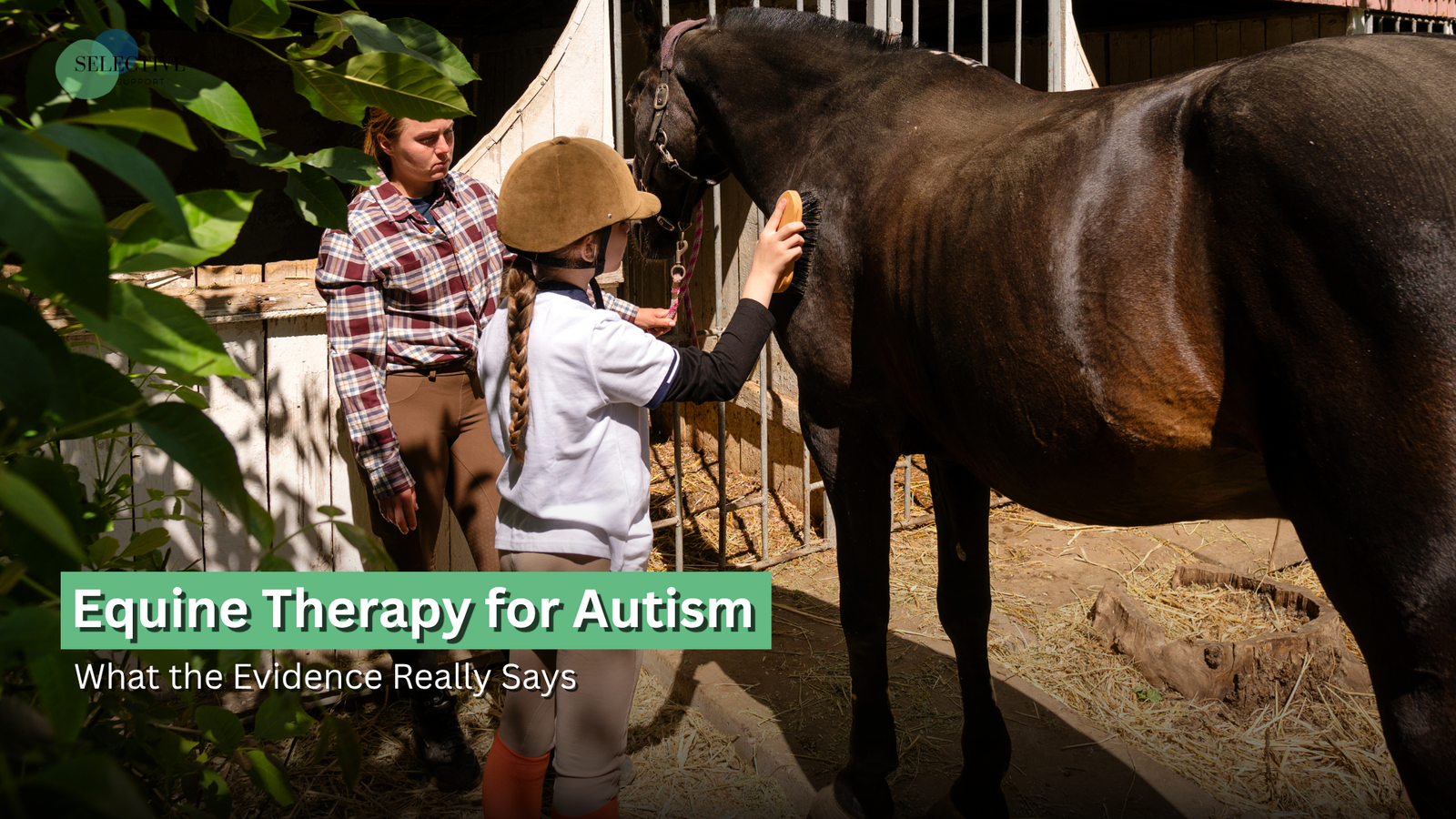
At Selective Support, equine sessions are ground-based and adapted to the participant’s communication style, comfort level, interests and goals. Activities can include grooming, observing horse behaviour, calm communication and structured problem-solving.
What Does the Evidence on Equine Therapy for Autism Actually Show?
This is where it is important to separate promising findings from proven outcomes.
The evidence for animal-assisted and equine interventions in autism is emerging, but mixed and generally limited in quality.
The NDIA’s evidence overview for interventions for autistic children reviewed systematic reviews of animal-assisted interventions. For equine-assisted interventions, it reported a positive finding for sensory behaviours, but the underlying evidence was rated low quality. It found null or mixed results across several other areas, including communication, cognition, motor skills, social-emotional outcomes, adaptive behaviour, quality of life and community participation.
That does not mean equine-assisted support cannot be useful. It means the research does not currently justify broad claims that it will reliably produce the same outcomes for every autistic participant.
More recent research has also found some encouraging results.
A 2024 systematic review and meta-analysis covering 45 animal-assisted intervention studies and 1,212 participants reported improvements in some measures, including social communication, irritability, hyperactivity and word use. However, it found no significant improvement in several other areas and highlighted important limitations, including a high risk of bias and a lack of long-term follow-up data.
There is another limitation families should know about: studies often group together very different animal-assisted approaches. Research described as “equine therapy” may include programs with different practitioners, methods and activities. The NDIA itself notes that terminology and intervention procedures are not well standardised.
So research into one equine program cannot automatically be applied to every other program.
What does that mean for your family?
A practical approach is to focus on individual goal attainment.
Instead of expecting equine therapy to produce a broad autism-related outcome, ask:
- What specific goal are we working on?
- Why might this environment help this person engage with that goal?
- Who is delivering the support?
- How will progress be measured?
- Are we seeing meaningful changes over time?
- Are any skills being used outside the equine setting?
If progress is not occurring, the support should be reviewed rather than continued simply because the participant enjoys horses.
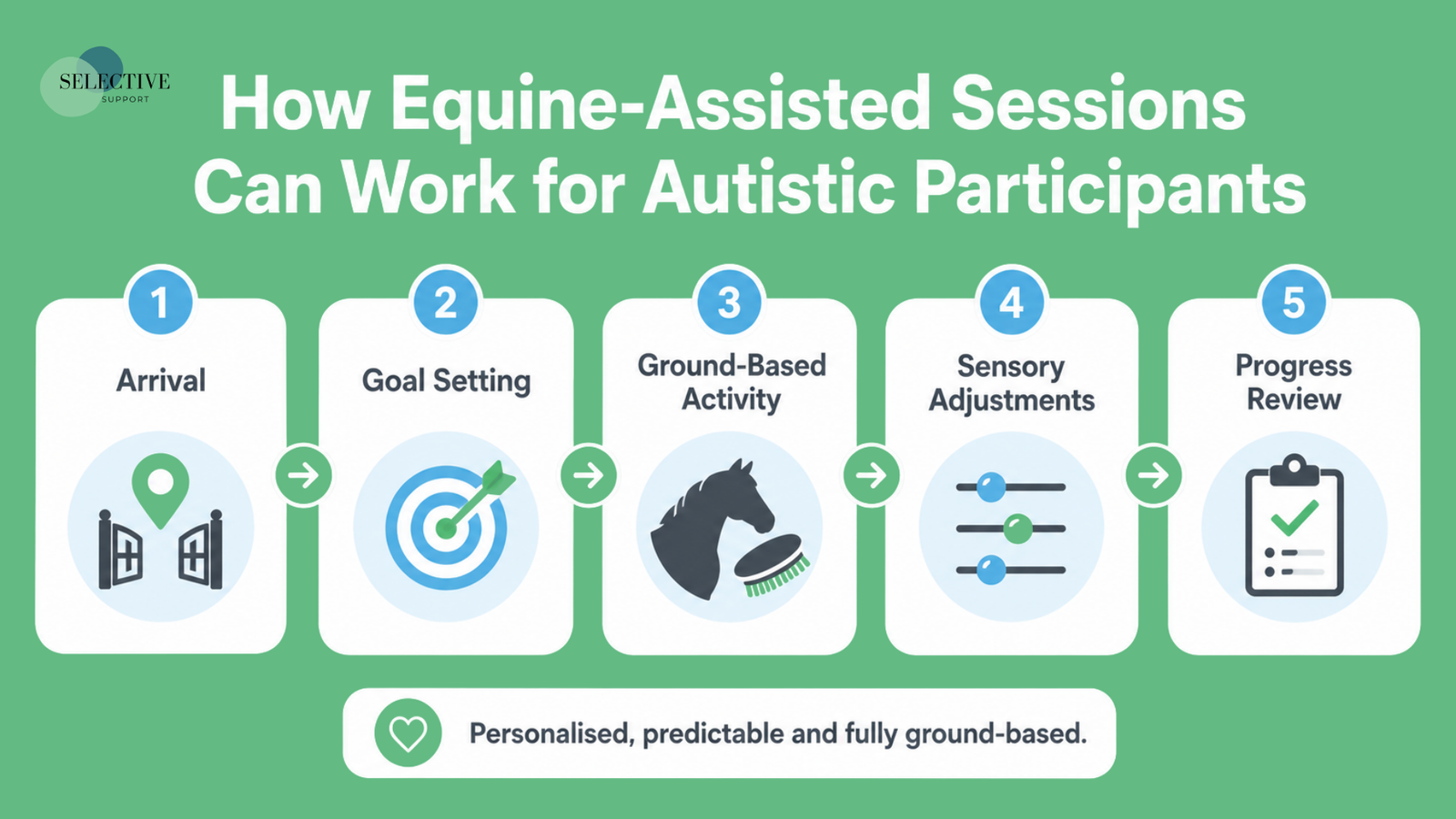
How Horse Therapy for Autism in Melbourne Sessions Can Work
Starting somewhere unfamiliar can be a significant step, particularly for a participant who prefers predictability or needs time to become comfortable in a new environment.
A good session should not begin with pressure to interact immediately.
At Selective Support’s Diggers Rest property, sessions are ground-based and led by an experienced developmental educator. The activity is adjusted to the participant’s comfort, communication needs and pace. No previous horse experience is required.
A session may follow a predictable structure such as:
- Arrival and settling in
The participant has time to become familiar with the environment and understand what will happen. - A clear goal for the session
The practitioner connects the activity to an individual developmental or NDIS goal - Ground-based activity
This might involve grooming, observing horse behaviour, practising communication, completing a simple course or working through a problem-solving task. - Adjustments when needed
Noise, proximity to the horse, pace, instructions and activity demands can be adapted to the participant. - Reflection and progress review
The practitioner considers what the participant practised and how this relates to their wider goals.
For some participants, predictability may be especially important. Others may need movement, choice, fewer verbal instructions or more time before approaching a horse.
The session should fit the person, rather than expecting the person to fit the program.
If you are comparing terminology such as EAL, developmental therapy and psychotherapy, read our guide to EAP vs EAL vs Equine-Assisted Therapy.
Autism, NDIS and Equine Therapy Funding
Having an autism diagnosis does not automatically mean equine-assisted therapy will be funded by the NDIS.
Current NDIS guidance says animal-assisted therapy may be an NDIS support where it is considered reasonable and necessary. It must relate to the participant’s disability, be in line with their plan, represent value for money and meet the relevant pricing requirements. The therapy also needs to be planned around individual goals and provided by a trained and qualified health professional.
The NDIS also requires evidence that therapy supports are likely to improve or maintain functional skills and independence. Simply calling a service “therapy” is not enough.
For an autistic participant, this means the funding discussion should focus on the functional need and goal, for example:
“The participant is working towards greater independence in managing emotional regulation during everyday activities.”
rather than:
“The participant has autism and would benefit from horses.”
The first explains the outcome the support is intended to address.
For a detailed explanation of eligibility, read Is Equine Therapy Covered by the NDIS?.
You can also learn more about our local NDIS equine therapy in Melbourne and how ground-based sessions are structured around individual goals.
Equine Therapy for Autism FAQs
1. Does equine therapy help autism?
It may help some autistic participants work towards specific goals such as regulation, communication, confidence or independence. Results vary between individuals, and it should not be presented as a cure or universal treatment.
2. Is equine therapy for autism evidence-based?
The evidence is developing. Some studies show promising results in particular areas, but the NDIA’s evidence review found much of the equine research to be low quality or mixed. Individual goals and measurable progress remain important.
3. Is equine-assisted therapy funded by the NDIS for autism?
It may be funded when it meets NDIS criteria, relates to the participant’s disability and goals, and is delivered as an appropriate professional support. An autism diagnosis alone does not guarantee funding.
4. What age is equine therapy suitable for?
Suitability depends more on the individual than a particular age. Selective Support welcomes children, teenagers and adults, with sessions adapted to the participant’s needs, comfort and goals.
Start With the Person, Not the Diagnosis
The most important question is not whether equine therapy works for “autism” as a whole.
It is whether a structured equine-assisted approach is suitable for this person, this goal and this stage of their NDIS journey.
For some participants, working alongside a horse may create an engaging environment for practising regulation, communication, confidence or everyday skills. For others, a different support may be a better fit.
A good provider should be willing to talk honestly about both possibilities.
Curious whether equine therapy suits your child’s goals? Book a free chat.